






Cloud-first
Business Applications
You want us to do a lift-and-shift from your 20th century on-premise data centre to AWS or Azure. Or you want us to design and build for you the kind of cloud-native application which Netflix or Atlassian would be proud of. We’re game.
Questions about Cloud-first Business Applications
The cloud is a tide you can’t stop. But it’s not easy to find a partner who groks cloud-first.
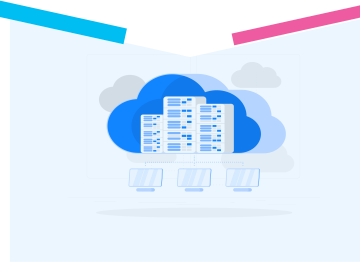
Cloud-first applications are designed to exploit features and services of clouds like Azure or AWS to the hilt, and often won’t work on normal on-premise servers in conventional data centres. They will use features which are available on a pay-per-use basis on clouds, features which are either hard or impossible to replicate on-premise.
“Running on the cloud” is not the same as “designed cloud-first”. It is very easy to lift-and-shift an on-premise application, with its 20th century thinking and architecture, to the cloud as is. A cloud-first application is totally different. They will use message buses, analytics engines, queues, non-SQL database services, for instance.
There are exactly three large cloud hosting services today: AWS, Azure, and GCP, and we can keep a degree of neutrality in our design and architecture such that only minimal (< 5%) code change will let you migrate among them. If your cloud strategy strives to be cloud-agnostic, then we can design your application with a cloud-first approach and still keep it largely cloud-agnostic.
There are unique security challenges of cloud-based systems, which no on-premise system needs to face. That said, by no means is it less secure than on-premise security. For instance, if your root account with AWS or Azure is broken into, servers or services can be deleted with a click of a button. But the flip-side is compelling too. No on-premise server farm with general-purpose firewalls or switches has the kind of secure networking and Layer 3/4 access control which cloud data centres can deliver. Firewall rules in cloud DC are often implemented in special purpose ASIC chips on netwoirk fabrics and motherboards which are impossible to circumvent over the network by an intruder.
Business Applications

CBS Business Portal
The school supplies distribution market is ripe for the next level of automation and third-party integration. We are helping CBS take the lead in this space at a national level.
View case study


1Pay
The best mobile apps look beguilingly simple. We understand the engineering which takes you there, and we worked with 1Pay to deliver a great experience to their logistics partners and truck drivers.
View case study

Keurix
The Keurix app was born on the cloud, and we nurtured its growth for the first few years. Keurix went on to re-shape the civil inspection business in The Netherlands, bringing in new levels of safety, compliance and scrutiny.
View case study

Vocational Training for UPSDM
The Mission’s stated goal in the project RFP was to serve about 25 lakh (2.5 million) candidates over a three-year period. However, the number of candidate registrations over the first two months exceeded 45 lakh (4.5 million). On certain days, new candidate registrations touched 2 lakh (200,000) in a single day. During this period, the software system performed reliably. The Mission is running successfully with well-defined processes and guidelines. Its entire lifecycle is managed through the single portal designed and developed by Remiges.
View case study

Actyv
Actyv has an awesome platform in a niche area, growing the distribution dimension of various industries. They understand cloud-first. We fit right in.
View case study